
Great Invention of Paper and Printing
Origins of Paper
Before the invention of paper, many ancient civilizations used alternatives for inscription. From around 2900 BC, the Egyptians used a thick material called Papyrus. People in Mesopotamia (what is now Iraq and parts of Syria, Turkey, and Iran) used clay tablets.
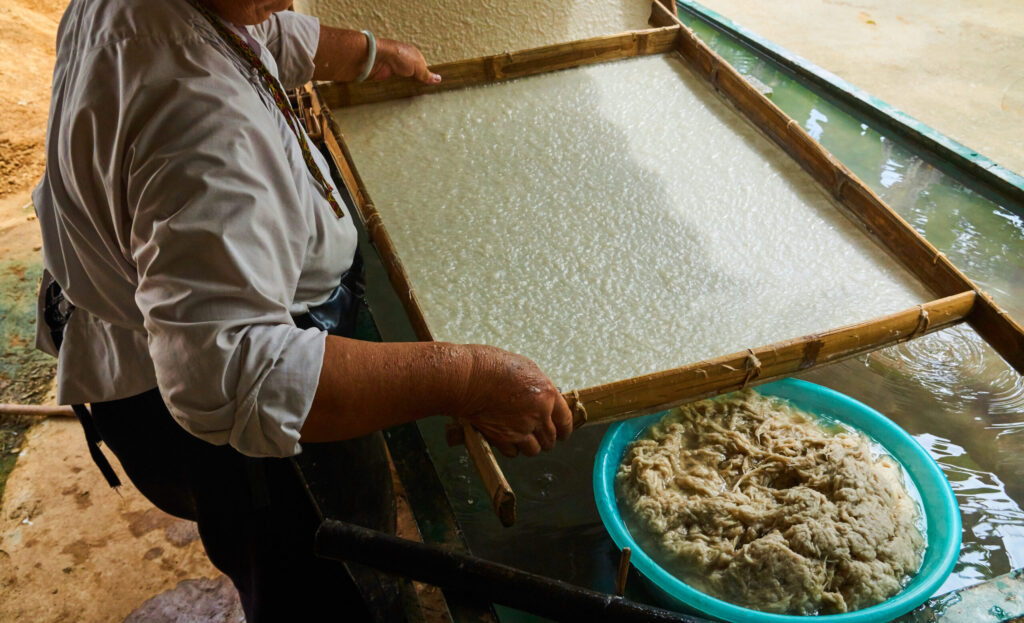
China also had a history of writing on bamboo, wooden slips, silk, and cloth before Cai Lun invented paper in the year 105. In an effort to make writing surfaces more accessible, he researched and experimented with commonly found materials such as old fish nets, bark, hemp, and rags. He processed them to make a thin and light surface, paper as we know it today. 300 years later, this invention traveled to West Asia and spread along with Islam. It wasn’t until the 1000s that paper finally reached Europe, and paper mills were established, meaning that most of Asia had started using paper long before Europeans had ever heard of the great invention.
True Father of Printing
According to historians and scholars, woodblock printing was first invented in China around the year 600. Before then, bronze or stone seals were used to make impressions on clay or silk. Woodblock printing was used to print books on various topics such as agriculture and medicine.
Although Johannes Gutenberg from Germany is commonly inaccurately taught as the “Father of Printing in schools worldwide, it was Bi Sheng, a man from China, who first invented the movable type roughly 400 years earlier during the Song Dynasty (960-1126). He replaced the well-established system of woodblock printing with a more efficient method using individual clay blocks of movable characters, which became known as movable-type printing. Around 1297, Wang Zhen, a Yuan dynasty official, improved Sheng’s design by replacing his clay pieces with wooden pieces, which he had processed to make them more durable. This development fastened the speed of printing. Then, in 1490, Hua Sui, a printer, further improved the movable type by using bronze, which proved even more durable than wood.
However, woodblock printing remained more popular in China for centuries to follow. The Chinese language contains thousands of characters, unlike European languages, which use 20-30 letters. This made movable-type printing less efficient than it would be in Europe in the 1400s, when Gutenberg began designing and exploring the art of printing.
Birth of Paper Money
Before paper money, bronze and copper coins with holes in the middle were strung together for large transactions. During the Tang Dynasty (618-907), merchants would leave their money with trusted agents or shops, who would record the amount of money collected on paper. This paper would then be traded for goods, and soon after, the government issued licenses to specific shops. In the 1100s, during the Song Dynasty, the government took control of this system and made government-issued paper money. Numerous money-making factories were established, each using a different mix of fiber in their paper to avoid counterfeiting. This highly organized and efficient system led to the introduction of the world’s first national currency, jiaozi, in 1265. This system soon spread to other regions, such as the Mongolian khanate, where in 1294, Ghazan Khan established a similar system. In 1661, almost 400 years later, paper money was adopted in Europe, in Sweden.
Food For Thought
Although people use these inventions daily, their history and their inventors are often overlooked. These were not isolated breakthroughs, but part of a pattern of innovation in China that transformed how knowledge is preserved and recorded globally.
The preservation of literature and the circulation of money are undeniably among the most important innovations that are still used today. The invention of paper money made it no longer necessary for people to carry extremely heavy stacks of coins. Likewise, in recent years, more people have been using e-money out of convenience. If the Chinese had not invented paper and money, who knows if we would have had e-money today?
Written by まりか