
Gemstones in Technology: Beautiful Stones That Power Modern Devices
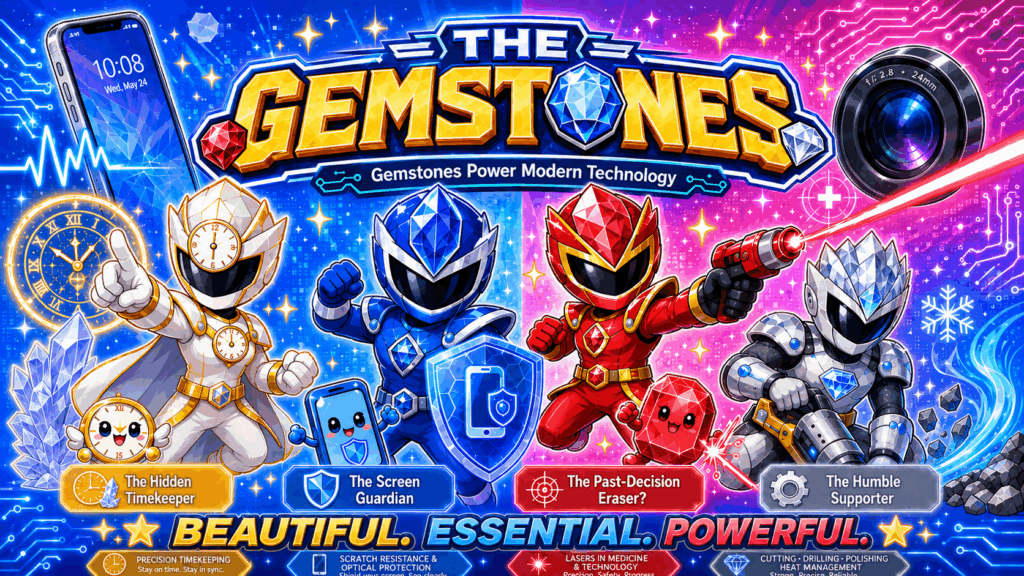
When you think of gemstones, you probably imagine sparkling jewellery worn at special events or displayed in luxury shops. They are often linked with beauty, wealth, and high prices. Occasionally, rare gemstones sold at auctions make headlines and renew our fascination with them. However, behind the glamour, many gemstones also play an important role in modern technology. In fact, some of them may be closer to you right now than you think, possibly even inside the device you are reading this on.
Quartz: The Hidden Timekeeper
Quartz is found in many parts of the world, including Brazil, the United States, especially Arkansas, Madagascar, Russia, and Switzerland. In technology, it is cut into thin slices and used in clocks and watches.
Quartz became important in timekeeping because of a scientific discovery. When an electric current is applied to a quartz crystal, it vibrates at a very stable frequency. Jay Bennett explains that quartz clocks improved greatly in the 20th century after this property was understood. These steady vibrations allow devices to measure time very accurately.
Without quartz, your phone might think breakfast is bedtime. Quartz is therefore a quiet but reliable timekeeper inside many devices.
Sapphire: The Screen Guardian
Sapphire is a blue gemstone known for its extreme hardness, second only to diamond. Because of this, it is used in technology to protect surfaces that must resist scratches.
In smartphones and watches, sapphire is used in camera lenses and protective covers. Kepenekci et al. explain that sapphire is useful for protective windows, optical systems, and sensor covers in industries such as aerospace, defence, and consumer electronics.
The sapphire used in technology is not natural gemstone material. Instead, it is synthetic sapphire made from aluminium oxide. This lab-grown version is preferred because it can be produced in large, perfectly shaped pieces and engineered to be both very hard and optically clear.
In short, it is sapphire that has been to engineering school and graduated with honours.
Ruby: The Past-Decision Eraser?
Rubies are also used in technology, especially in lasers. Like sapphire in technology, the ruby used here is not a natural gemstone found in jewellery. Instead, it is a synthetic crystal made of aluminium oxide with a small amount of chromium.
When this crystal is exposed to strong light, the chromium atoms help produce a focused beam of light called a laser. In fact, the first working laser in history was a ruby laser.
Today, lasers are used in medicine, communication, and industry. For example, ruby lasers can be used in treatments such as tattoo removal.
It can be said that rubies may help erase your past decisions, quietly and precisely.
Diamond: The Humble Supporter
Diamonds are best known for their beauty, but in technology they are valued for their hardness and ability to manage heat.
Because diamonds are extremely hard, they are used in cutting, drilling, and polishing tools. In electronics, they are also useful because they conduct heat very efficiently. This helps prevent high-performance devices from overheating.
In other words, despite their dazzling appearance, diamonds also play a surprisingly humble role behind the scenes.
The Glamour and the Function
The examples above show that gemstones are more than beautiful objects. Each one has a special property that makes it useful in technology. Quartz vibrates steadily and helps devices keep time. Sapphire resists scratches and protects delicate surfaces. Ruby can produce laser light, and diamond can cut hard materials and carry heat away.
From clocks and screens to lasers and electronics, gemstones show that beauty and usefulness can exist together. So the next time you see a sparkling gemstone, remember that it may look like something for a crown, but it could also be quietly working inside your phone.
Written by Everett Ofori