
Hiroshi Sugimoto’s Extinction: A Circle of Endings and Beginnings
Do you know Hiroshi Sugimoto?
Sugimoto is a world-famous contemporary artist. Since the 1970s, he has worked in both Japan and the United States. His work includes photography, architecture, stage production, and many other fields.
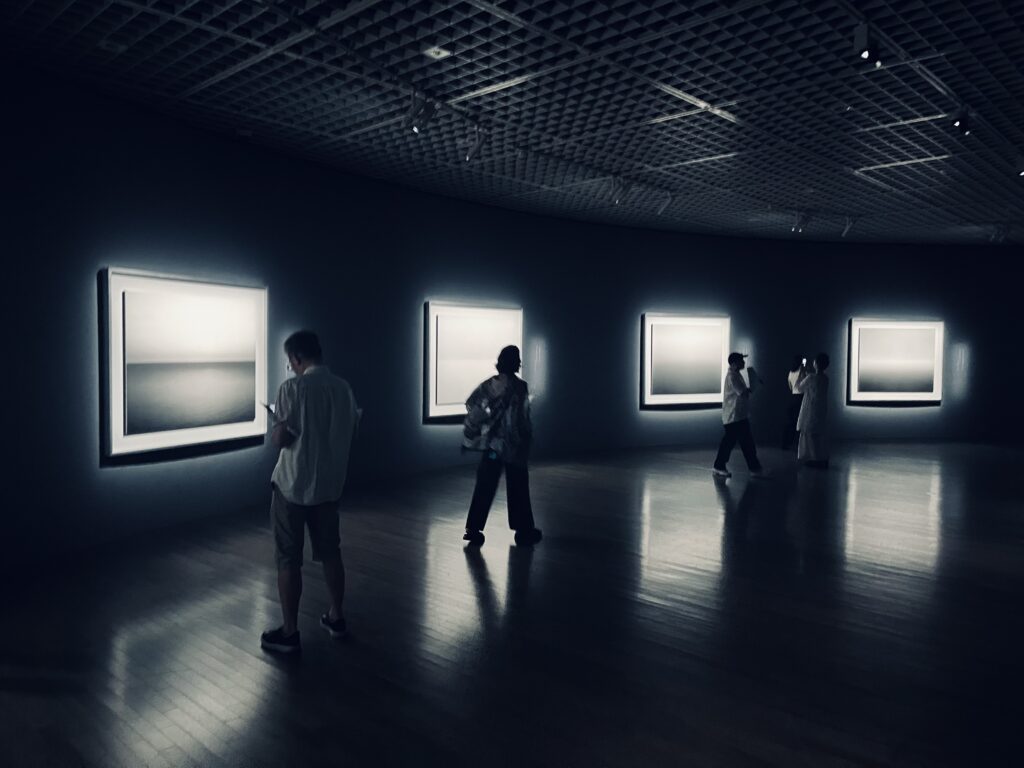
Now, the National Museum of Modern Art, Tokyo, is holding a photo exhibition called HIROSHI SUGIMOTO: EXTINCTION. It shows Sugimoto’s silver gelatin photographs, which can be seen as the starting point of his art.
In this article, we will introduce the exhibition. We will also look at the main ideas in Sugimoto’s art and the meaning of the word “extinction.”
Who Is Hiroshi Sugimoto?
Hiroshi Sugimoto was born in Tokyo in 1948. He moved to the United States in 1970. Since 1974, he has worked as an artist while traveling between Japan and New York.
He works in many fields, including photography, architecture, stage arts, and writing. His works often explore ideas such as time, memory, and existence. They are highly respected around the world.
Questions About Time and Light
The exhibition shows about 60 works, from Sugimoto’s early photographs to his recent ones.
The first series visitors see is called Dioramas. These photographs show dioramas at the American Museum of Natural History in New York.
A camera usually captures something that is moving and stops it in one moment. However, the subjects in these photographs are dioramas, and they do not move. They are already still.
But after they are printed as black-and-white silver gelatin photographs, they seem full of life. It feels as if the animals were moving from the beginning. This is the interesting part of the series.
The exhibition also includes the Theaters series. Sugimoto photographed an entire movie with a long exposure, from the beginning to the end. In this way, time is captured in a single photograph.
Another series is Seascapes. It expresses Sugimoto’s question:
“Can people today see the same view that ancient people once saw?”
These works show that questions about time and light are at the heart of Sugimoto’s art.
What Do the Blurry Photographs Mean?
As you continue through the exhibition, you will see photographs of famous buildings, such as Villa Savoye, designed by Le Corbusier, and the former World Trade Center in New York.
At first, they look normal. But when you move closer, you notice something unusual. The buildings are out of focus.
Sugimoto explains this series in these words:
“I used a large-format camera and made the image out of focus. I thought this might recreate the architect’s vision before the building was built.”
This series is shown in a section called Forms of Ideas. Looking at these photographs is like looking into someone’s mind. They show not only buildings but also ideas.
Sugimoto often uses bold methods to express the questions he asks himself. Because of this, many people see his photographs as conceptual art, where the idea itself is an important part of the artwork.
Looking at the Beginning Through “Extinction”
The last section of the exhibition is about Extinction.
Sugimoto believes that silver gelatin photography is coming to an end because of digital technology and the growth of digital media.
If one kind of media has an ending, it must also have had a beginning.
In this exhibition, fossils are presented as a way of recording the past. Prints are also made from 19th-century negatives left by William Henry Fox Talbot, one of the pioneers of photography. Through these works, Sugimoto shows the human desire to stop time and keep a single moment by using silver gelatin photography, a medium that is disappearing.
He uses a medium that is reaching its end to express its beginning.
For this reason, Extinction is not only about an ending. It may also be an exhibition about the circle of beginnings and endings.
Today, digital cameras are common, and photographs are no longer seen as perfect proof of reality. Because of this, the silver gelatin photographs in this exhibition have a strong impact. They show things that were really there and moments that really existed.
If you have the chance, visit the exhibition and experience the power of HIROSHI SUGIMOTO: EXTINCTION for yourself.