
Wearable Tech “E-Tattoos” That Measure Stress
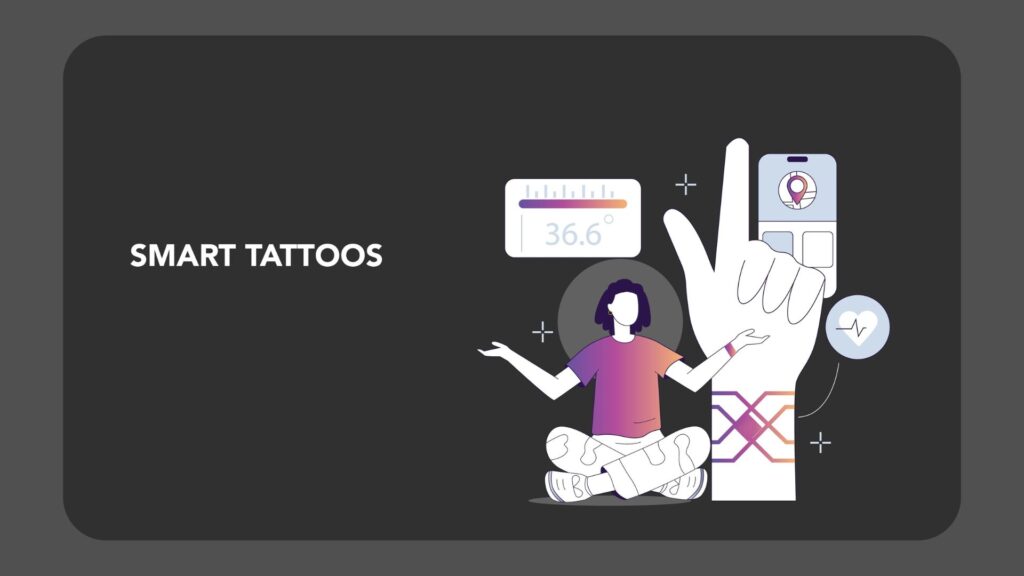
What if your tattoo could whisper, “Hey,man.Take a deep breath”? E-tattoos are ultra-thin, skin-like stickers that track signals your body already makes, like tiny changes in sweat and skin conductance. Put one on your forehead or palm, and it can estimate stress or mental workload in real time. Think of it as a very quiet coach that sits on your skin, not your shoulder. Researchers at UT Austin recently showed a forehead e-tattoo that reads brain and eye signals together to gauge cognitive load.
How it actually “feels” your stress
When you are tense, your nervous system talks to your sweat glands. That changes the skin’s electrical properties. E-tattoos pick up those tiny shifts with soft sensors, especially on high-signal spots like the palm. A team working with graphene e-tattoos has shown palm sensing for electrodermal activity, a strong window into arousal and stress responses. In plain English, sweaty palms finally have a purpose.
Why a sticker beats a strap
Traditional wearables like smartwatches can slip, squeeze, and miss signals when you move. E-tattoos are thin like a bandage, stretch with your skin, and sit exactly where the signal is strongest, even when life gets busy. Newer prototypes also combine multiple channels at once—for example, eye movements plus brain-adjacent signals on the forehead—to get a clearer picture of how “loaded” your brain is during a task. That multimodal approach is a key part of the recent UT Austin demo.
Biohacking for everyday life
Over time, the system can learn your biorhythms and suggest smarter breaks. Imagine your e-tattoo nudging your phone: “Take a 60-second reset.” Your standing desk moves itself. Your calendar learns not to stack hard meetings when your hormone levels are shifting. Your music app picks a calmer playlist when your cognitive load spikes, freeing you from having to micromanage your life. That is the near-term promise as these patches move from lab to life.
Far future: a quiet “health layer”
Researchers are already pushing toward skin-like systems and noninvasive biochemical sensing on skin. In a decade or two, e-tattoos could merge with smart clothing and ambient sensors to create a health layer that forecasts overload before you feel it, spots early drift in sleep or mood, and adjusts your environment accordingly. Our day-to-day life could start to look a little like a scene from a movie we’ve seen, minus the killer robots. (Hopefully.)
Culture shift: from ink to insight
Old-school tattoos say, “This is who I am.” E-tattoos say, “This is how I am, right now.” Does this hint that our culture is learning to embrace a more fluid state, not only a fixed idea of identity? Either way, tattoos and e-tattoos share one theme, and that’s agency. You wear them to feel in charge and in touch with your own body, and to feel empowered by the knowledge that you are the author of your own life. That pursuit of agency may be the constant that carries us through a fast-changing world.
Written by SAKURACO