
Groupthink: When Teamwork Becomes Dangerous
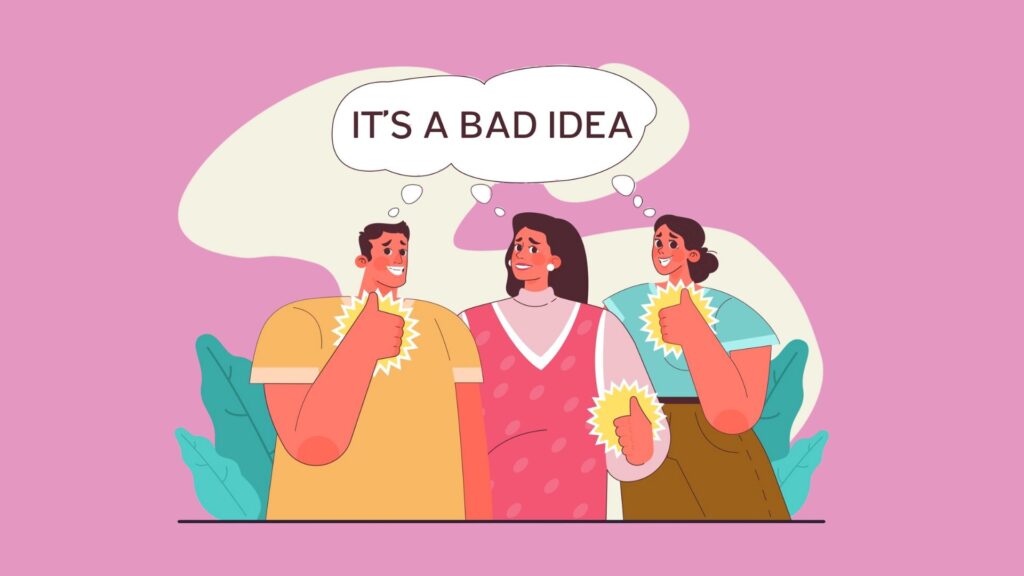
When people work together, they can achieve great things. Monuments such as bridges and towers remind us that teamwork can produce remarkable results. However, history also warns us about the dangers that arise when people stop thinking for themselves and simply follow a powerful leader or a popular idea. This dangerous pattern of thinking is called groupthink.
What Is Groupthink?
Groupthink occurs when the desire for harmony or agreement within a group becomes so strong that it prevents people from thinking critically or expressing different ideas. Fernandez (2007) defines groupthink as a situation in which one or two strong personalities control a group so completely that other opinions are pushed aside. Similarly, Merriam-Webster describes it as “a pattern of thought characterized by self-deception, forced manufacture of consent, and conformity to group values and ethics.”
Self-Deception
One of the most harmful aspects of groupthink is self-deception. People may join a business, religious group, or political movement because they genuinely believe in its purpose. At first, everything may seem positive and exciting. Over time, however, problems may begin to appear, such as broken promises or unethical behavior. Instead of trusting their own instincts, members ask others in the group, who often reassure them that nothing is wrong. Years can pass before individuals realize that they have lost valuable time, damaged relationships, and harmed themselves or others.
Conformity to Group Values
Groupthink can also be seen in everyday work culture. In Japan, for many years, a common belief was that employees should not leave the office before their boss. Even when their work was finished, many staff members stayed late and pretended to be busy. This example shows how group rules can survive simply because no one feels brave enough to question them.
The Bay of Pigs Invasion and President John F. Kennedy
The concept of groupthink was developed by psychologist Irving Janis in his book Victims of Groupthink (1972). In this book, he analyzed the failed Bay of Pigs invasion, a U.S.-supported military attack on Cuba in 1961. The goal was to remove Fidel Castro’s government, but Cuban forces successfully defeated the invading troops.
Janis argued that President John F. Kennedy’s advisers suppressed their private doubts during the planning process. Many advisers believed that the Central Intelligence Agency (CIA) had carefully prepared the invasion and fully understood the risks. The CIA designed the plan, trained Cuban exile fighters, and strongly promised success to the president and his team. As a result, advisers were afraid to challenge the proposal. In effect, highly intelligent and experienced leaders stopped thinking critically and agreed with the group, leading to a disastrous outcome (Janis, 1972).
The Antidote to Groupthink
Kennedy learned key lessons from this failure. In later meetings, he encouraged open disagreement and sometimes left the room so advisers could speak more freely. He also appointed “devil’s advocates,” people whose role was to challenge popular ideas.
Fernandez (2007) explains that leaders should avoid sharing their own opinions too early and should reward those who speak honestly, even when their views are uncomfortable. Janis (1972) stated that “the main principle for preventing groupthink is vigilance and the open airing of differences of opinion.”
What About Us?
In the end, groupthink is not only a historical problem but also a personal one. Whether we are leaders or group members, we must learn to recognize warning signs and have the courage to think independently.
Written by Everett Ofori