
Return of Basant
History of Basant
For hundreds of years, Basant, also known as Jashn-i-Baharaan has been celebrated and deeply embedded in the culture of the province of Punjab. During the partition of India in 1947, Punjab was split into two parts in newly-formed Pakistan and India. The word Basant originates from the Sanskrit word, “Vasant”, meaning spring. Hence, Basant is celebrated on the fifth day of Magh, in the Hindu lunar calendar as the end of cold winter times, the beginning of a bright and warm spring, and signifies the blooming bright yellow mustard fields.
Under Maharaja Ranjit Singh during the Sikh rule in the 19th century, Basant became a formal celebration especially in the cities of Lahore, Amritsar, and Kasur. Bright-colored kites would light up the sky as people celebrated with music, dances, and laughter. Historian Nazir Ahmad Chaudhary wrote, “Basant was not merely the act of flying kites; it was the moment when Lahore lifted its head towards the sky. For a few days, the city forgot its division – rooftops became shared spaces, strangers exchanged greetings, and even silence felt festive.” “No one asked who believed in what. The kite did not inquire whether the hand that released it was Muslim, Hindu, or Sikh. Basant belonged to the season – and the season belonged to everyone.”
Kite-Flying Festival of Basant
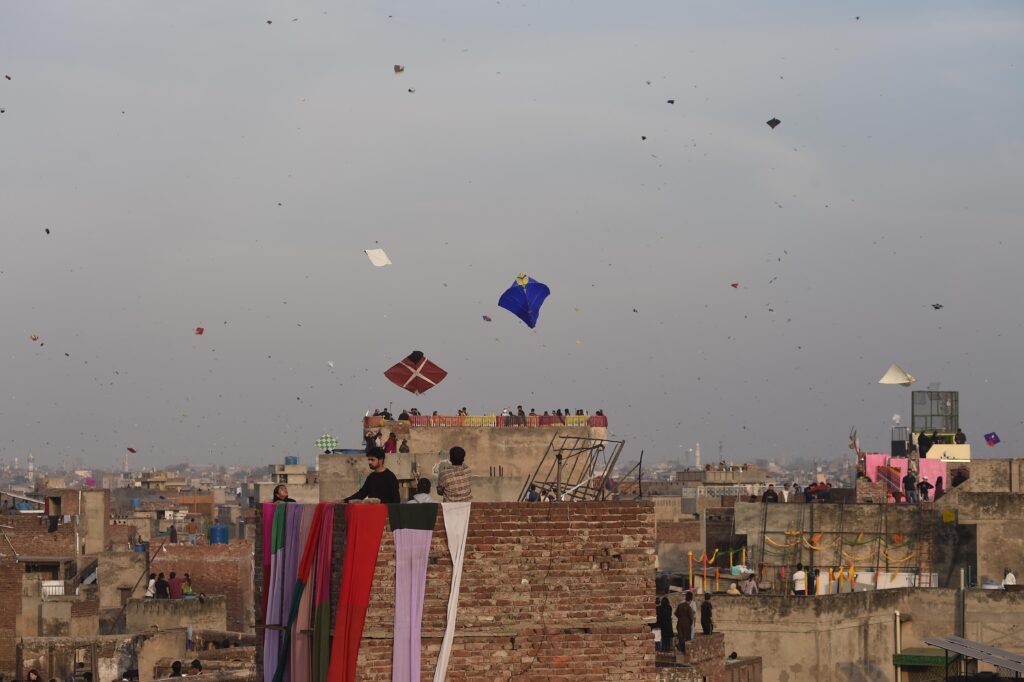
After almost two decades, Basant made a return to Lahore. Following many deaths due to the use of metallic or chemical-coated string and other safety concerns, Basant was banned in 2007. Before the ban, basant was celebrated in many areas of Pakistan each year. With its own set of vocabulary, Basant has always been more than just a festival. As Salman Tahir writes, “For many in Lahore, Basant has always been this quiet rebellion against gravity. In narrow streets where life presses close, the rooftop becomes a stage for liberation.”
This year, roughly 4,600 vendors registered with the government to sell kites and strings. Kites made up of beautiful designs and colors light up the sky, soaring high and free. People celebrating Basant also have a competitive spirit in them, often challenging other kites and severing their string. The winner shouts “Bo-Kata!” (hacked!) to signify their victory. Kite flying was a skill passed on from generation to generation, once playing a vital role in Punjabi identity and culture. Basant defined community, love, and joy.
Politics of Basant
This is not to say that the return of Basant has not been met with criticism. The government has been criticized for reviving the festival for political gain, as political unrest continues to ensue almost three years after what Amnesty International called the arbitrary arrest of former prime minister, Imran Khan in 2023. Pakistan Muslim League-Nawaz (PML-N) were brought into power after the general elections on February 8th, but the results were heavily contested by opposition parties leading to a nationwide crackdown on protests.
However politically motivated the return of Basant may be, it is important to never forget the importance of joy. Joy in times of deep despair is a form of resistance of the best kind. As Tahir Kamran states, “In a world increasingly suspicious of collective pleasure, Basant offers a quiet yet powerful lesson – that to celebrate the seasons together is also to reaffirm faith in one another.”
Written by まりか