
Festivities of Eid
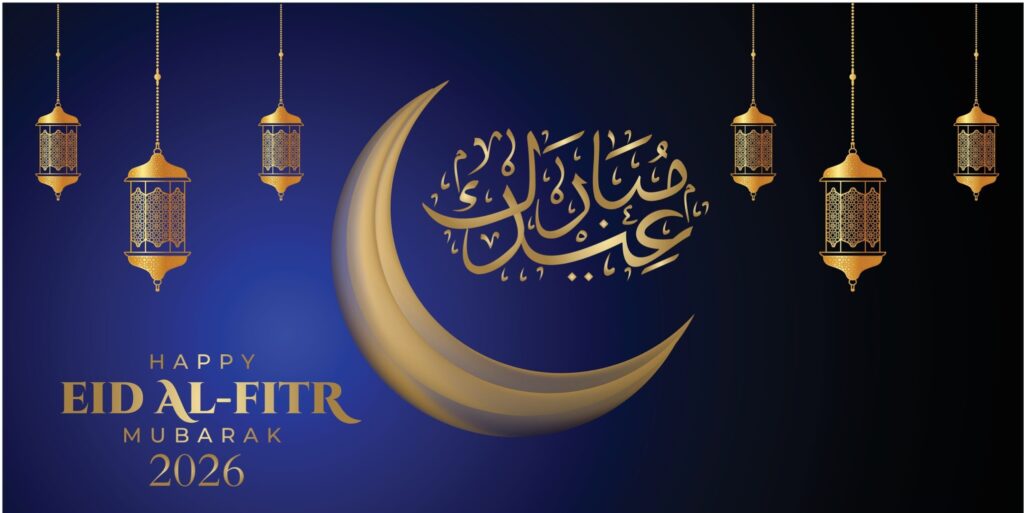
Eid
“Eid”, meaning “festival” or “celebration”, is celebrated among Muslims twice each year. Eid al-Fitr is celebrated on the first day of Shawwal, the 10th month in the Islamic calendar. Fitr means “breaking the fast”. The Islamic calendar is a lunar calendar that consists of 12 lunar months, and a new month begins when a new crescent moon is sighted. It is used today to determine the Islamic rituals such as fasting and Hajj (pilgrimage), and holidays such as Eid.
The second time Eid is celebrated, Eid al-Adha, it is on the 10th of Dhul-Hijja, the 12th and final month of the Islamic calendar. Eid al-Adha is known as the “feast of sacrifice”. Eid falls on different days each year.
Ramadan
The month of Shawwal is preceded by the 9th month in the Islamic Calendar, Ramadan, the holy month of fasting. Muslims fast from dawn to dusk every day in this month, abstaining from food and drink. This is a time for self-restraint and sacrifice, for deep religious reflection, and for empathizing with those less fortunate. Ramadan is a holy month when the gates of hell are said to be closed, and the gates to paradise are opened. Many Muslims go to the mosque to pray and recite the Quran for many hours, deepening their connection to God and the religion. In addition to the five daily prayers in Islam, there is a special night prayer called the “Tarawih” during the month of Ramadan. As the last ten days of Ramadan are the most blessed nights of the year, many Muslims who are able also give more charity and alms during this time.
Although Eid traditions vary from country to country, one thing remains the same: gathering and spending time with loved ones.
Eid al-Fitr
On the day of Eid al-Fitr, Muslims wake up very early in the morning to attend Eid prayer at the mosque and prepare food for the celebration. On Eid, Muslims follow the way of the last prophet in Islam, Prophet Muhammad, by taking a bath or shower, wearing fresh clothes, praising God on the way to prayer, embracing family, friends, and neighbors, and giving charity, among many other acts. Every self-sustaining Muslim who is capable of giving food is required to give Zakat al-Fitr, a donation of food, before the end of the month of Ramadan, before the Eid prayer. Children receive gifts and money, known as “Eidi”. Eid al-Fitr is celebrated for one day, but in many countries, people celebrate it for three days.
Eid al-Adha
Eid al-Adha is celebrated over the course of three days. After the Eid prayer, shortly after sunrise, on the first day, an animal (goat, sheep, cow, or camel) is slaughtered as Qurbani (sacrifice), to remember the story of the sacrifice that Prophet Ibrahim made for God. The portion of this meat is given to people in need, who may not have been able to afford meat otherwise. Charity and helping others are core values of Islam, and are seen in every aspect of Muslims’ lives. As with any other Islamic ritual, Muslims follow the example of the Prophet Muhammad in various acts of worship.
Message of Eid
Eid is a celebration that reinforces the values of shared humanity, unity, empathy, compassion, love, and generosity. In a world that is so divisive, isolating, and cruel, Eid teaches us the importance of community care; to never let anyone be left behind. The culture of Muslims worldwide is one of love, care, and hospitality, and that is visible in almost every Muslim household and country.
Written by まりか