
Pad Man: An Opportunity to Think About Period Poverty
Pad Man – A Heartwarming Movie
Pad Man is a movie based on a true story about Arunachalam Muruganantham, who sacrificed his whole life and devoted it to manufacturing low-cost, hygienic sanitary napkins for women in rural areas in India. After he married his wife, he noticed that every month during her period, she was sleeping outside and using a rag as a sanitary napkin. When confronted about this, she said that there was not enough money to buy napkins for her monthly period, and this is what women have been doing in the area for a very long time. Worried about her health, he starts experimenting using different materials to make pads for her, but remains unsuccessful. As time goes on, due to the stigma of menstruation, he is shunned by his community.
The movie goes on to show his journey of trial and error in manufacturing pads. This movie is not just a heartwarming story about a man’s love for his wife, but a beautiful film that shines a light on the issue of period poverty.
What Exactly Is Period Poverty?
Period poverty is a global public health issue that affects millions of people each year. According to UN Women, period poverty is defined as “the inability to afford and access menstrual products, sanitation, and hygiene facilities, and education and awareness to manage menstrual health.” Period poverty is an issue that not only affects women, but also transgender men and gender nonbinary people. Stigma surrounding menstruation, along with harmful policies like the “pink tax”, have created a problem that further marginalizes vulnerable people. According to research conducted by the University of Wisconsin-Madison Institute for Research on Poverty, about 34% of trans men and 24% of gender nonbinary individuals live in poverty in the United States, compared to 16% of cisgender people.
In the US, 1 in 4 teens and 1 in 3 adults struggle to afford period products, while in the UK, 3 in 10 people do. This reportedly affects more people of color and low-income families. This shows that it is an intersectional issue that is not only rooted in gender discrimination, but also racism and capitalism. For example, in Japan, more than 40% of women work part-time, and they do not receive benefits because of their contracts, leaving especially single-mother households financially insecure.
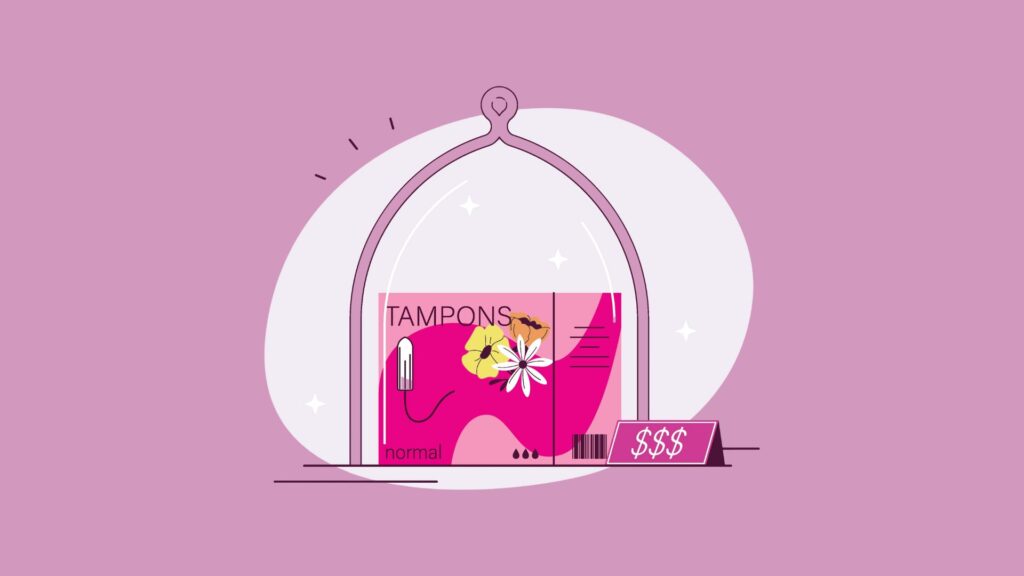
According to EBSCO, “pink tax refers to the higher prices often charged for products and services marketed towards women compared to similar items aimed at men.” Although sanitary products are essential goods, they are still taxed at a higher rate than other goods, making them inaccessible to many who face financial burdens. Similarly, in Japan, menstrual goods are taxed at 10% in comparison to other necessities like food and beverages, which are taxed at 8%. On the other hand, due to efforts by activists, some countries are working on lowering taxes for period products, and several countries, including Australia, Canada, India, Rwanda, and others, have made tampons and other products tax-free. In 2020, Scotland became the first to pass legislation that will provide free sanitary products at schools and other public areas.
The Situation in Japan
The Ministry of Health, Labour, and Welfare of Japan conducted its first study on period poverty in 2022. 8% responded that they “frequently” or “occasionally” struggle to buy period products. Out of the 8%, 50% of the respondents reported trying to change their pads less often, and 43% said that they use toilet paper or tissue paper instead. About 70% of the people who reported using toilet paper and tissue paper said they experienced itchiness, and 40% of the respondents also said that they gave up spending money on leisure activities and private events to make up for buying pads.
An organization called #minnanoseiri (menstruation for everyone) has been working to address the issue of period poverty in Japan. In 2019, Ayumi Taniguchi, co-chair of the organization, launched a petition to lower the consumption tax on sanitary goods when it was raised to 10%. The petition has gained over 80,000 signatures. From October 2020, they also started collecting online surveys on how menstruation impacts individuals’ financial stress. One respondent said, “I have to be stingy and use one nighttime pad for the whole day, which makes things smell bad and itch.” Unhygienic menstrual practices lead to a higher risk of developing diseases that many have to endure, in pain and often in silence.
According to the Global Gender Gap Report, Japan ranked 118th out of 148 countries, one of the lowest in the G7 countries. Earlier this year, a Japanese prefectural assembly member posted, “Like toilet paper, I want sanitary pads to be equipped everywhere,” on her X. Within the span of 3 days, the assembly’s secretariat received 8,000 emails from the same address threatening to kill her. Experts state that this reflects deeply ingrained beliefs in Japanese society, where outspoken women are often silenced by gender-based harassment. Chisato Kitanaka, an associate professor of sociology at Hiroshima University, stated that although death threats are extreme, violent messages towards publicly outspoken women are common in Japan. As published in various news articles, many politicians in Japan have continued to make outrageous remarks regarding women, LGBTQ+ people, reproductive rights, etc., spreading a culture of tolerance towards overt discrimination and hate speech. However, organizations like #minnanoseiri and legislative wins from other countries give us hope and let us imagine what our society could look like.
Written by まりか