
World’s First University; Founded by a Muslim Woman
Fatima-al Fihria
Born around 800 AD in the town of Kairouan, in present-day Tunisia, Fatima al-Fihriya was the daughter of a successful merchant. Much about her personal life remains unknown, except for the records kept by historian Ibn Abi-Zar, largely due to a fire that broke out in the library of the University of al-Qarawiyyin in 1323. Her family deeply valued learning, and she and her sister Maryam were well-educated.
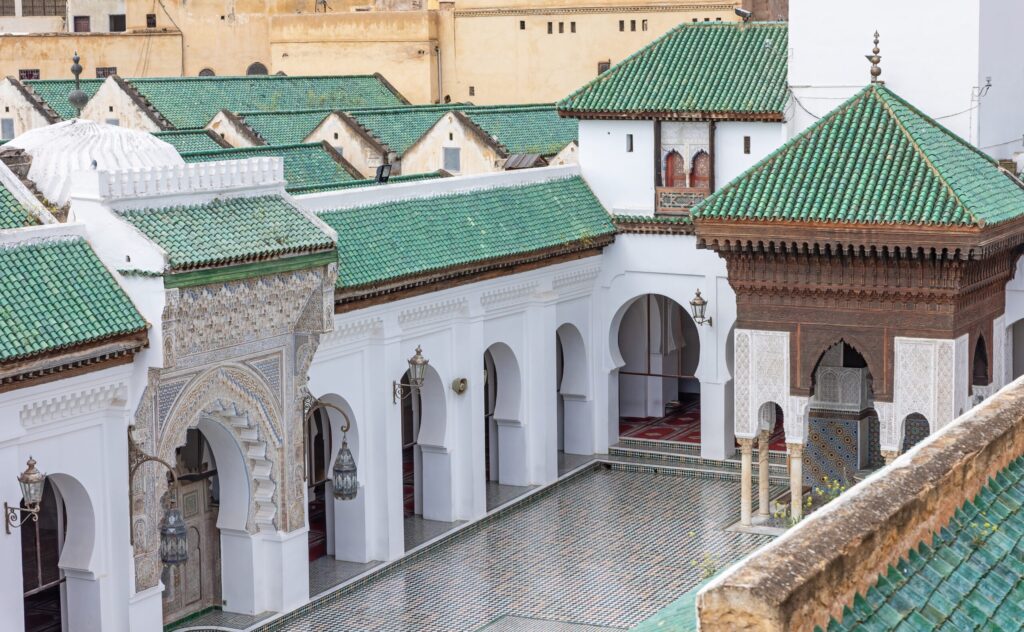
When her father died, as per Islamic inheritance law, she and her sister had the freedom to use the inheritance as they saw fit. She used that fortune to build the al-Qarawiyyin mosque, which later also became a university, and Maryam built the Al-Andalus Mosque, after noticing that the mosques in Fez, Morocco, were becoming overcrowded due to an increase in believers. The mosque was named after the Andalusian (Iberian Peninsula) refugees who fled to Fez.
University of al-Qarawiyyin
Initially, al-Qarawiyyin, meaning “University of the People from Kairouan”, was built as a mosque for her community, where Islamic wisdom and knowledge could be taught and spread, and used to unite refugees and migrants despite their many challenges. However, similar to European higher education, which took place in Christian cathedral schools and monastic schools, where monks and nuns taught classes, mosques were also a place for higher education, free of charge. Al-Qarawiyyin focused mainly on Islamic theology and law, and interestingly enough, law and theology were also the main subjects taught at the first European universities in Bologna and Paris, respectively. As time went by, al-Qarawiyyin expanded the subjects taught, and students studied poetry, philosophy, math, science, etc. The practices first established there are still taught today in universities worldwide. The University of al-Qarawiyyin was founded by a young Muslim woman centuries before prestigious institutions such as the University of Oxford and Cambridge.
Some well-known graduates of al-Qarawiyyin include Ibn Rushd, a brilliant philosopher, physician, and judge, who produced summaries and provided alternative methods of reasoning and persuasion regarding Aristotle’s philosophy, and Ibn Khaldun, a prominent historian, philosopher, and social scientist, well-known for his work, The Muqaddimah, which discusses the history and theories of alchemy. It is said that other graduates include Jewish philosopher Maimonides, who systematized all of rabbinic law, and Pope Sylvester II, who made major contributions to academic thought and is said to have introduced Arabic numerals to Europe after studying there.
Symbolism of al-Qarawiyyah
The university was created as a place for people to gain knowledge to spread across the world. Universities in the West, such as the University of Bologna and the University of Oxford, both established in the ninth century, adopted al-Qarawwiyah’s structures of learning at the time of foundation. Moreover, the story of Fatima and her commitment to her community and education shows the vital role that Muslim women played in core areas of Islamic society. She showed great leadership and lived with confidence, challenging commonly known beliefs about Muslim women and setting a clear path for those who followed, bringing awareness to the importance of higher education and women’s rights.
The University of al-Qarawiyyah still exists today, and is recognized as the world’s oldest operating educational institution by UNESCO. The university’s library is well-known for its extensive collections of Islamic texts and manuscripts.
Written by まりか